
ANEEL approves battery auction rules and lowers reference investment
ANEEL approved the rules for two battery storage auctions scheduled for December. The revision lowers the reference investment used to calculate bidders’ financial guarantees and minimum equity requirements.
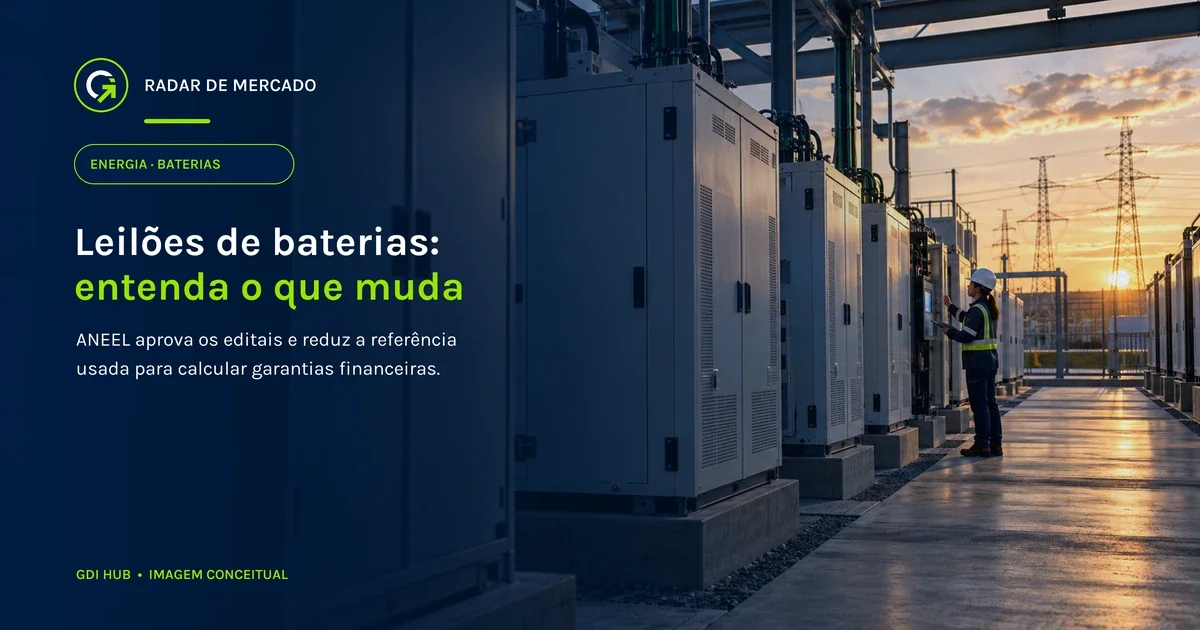
Brazil’s National Electric Energy Agency (ANEEL) approved the rules on October 27 for the country’s first two auctions dedicated to battery energy storage systems. The auctions are scheduled for December 2 and 4, 2026. They will contract capacity for 15 years, starting in August 2028.
The first auction will include domestic-content requirements. The second will be open to projects that meet the technical rules without that requirement. The systems must be able to deliver power for up to four hours per cycle and fully recharge within six hours.
What changed in the financial requirements?
ANEEL lowered the reference investment used in the auction documents from R$9.8 million to R$6 million per megawatt (MW). The revision also reduced the financial guarantees and minimum equity required from participants. According to the agency, the adjustments may lower entry barriers and increase competition.
In simple terms, this reference is an estimate used as a yardstick for some financial calculations. It helps size requirements according to the capacity of a system. It is not the price paid to the auction winner, and it does not mean every project will actually cost that amount per MW.
CAPEX is short for capital expenditure: the investment required to build or equip an asset. Here, reference CAPEX is an estimate per MW used to set some financial requirements. It is not the annual contract payment, which is defined separately as fixed revenue.
What to watch before the auctions
The public consultations on the auction rules received nearly 2,500 contributions, and the approved version includes changes to participation rules. The decision gives bidders more clarity on financial and operating requirements. The cost-allocation discussion is still ongoing: current rules assign the charge to power generators, while ANEEL’s consultation on the calculation method remains open until November 6.
For companies assessing projects, suppliers or partnerships in energy storage, lower guarantees may affect the financial preparation needed to bid. The actual impact will depend on each project, its financing structure and the final rules that apply to each bidder.
GDI Hub follows the developments connecting storage, renewables and business opportunities. Talk to our team.
Sources: ANEEL; Reset; EPE — PDE 2035; ANEEL — cost-allocation consultation.